How to Win in 2026:The 4 Questions That Will Shape Your Year
Before you set your goals, make four conscious decisions that can reshape your relationships, presence, mindset, and purpose.
Every January, we hear a lot about goals and resolutions. But very few conversations focus on the place where those goals are born: your mind. Here's the key: your mind isn’t one thing—it’s two.
Imagine your mind as a large circle. Now slice out a razor-thin sliver, representing roughly five percent of the circle. Neuroscientists estimate that this five percent represents your conscious mind—the intentional, deliberate part that says, “I choose this,” or “I’m thinking this.”
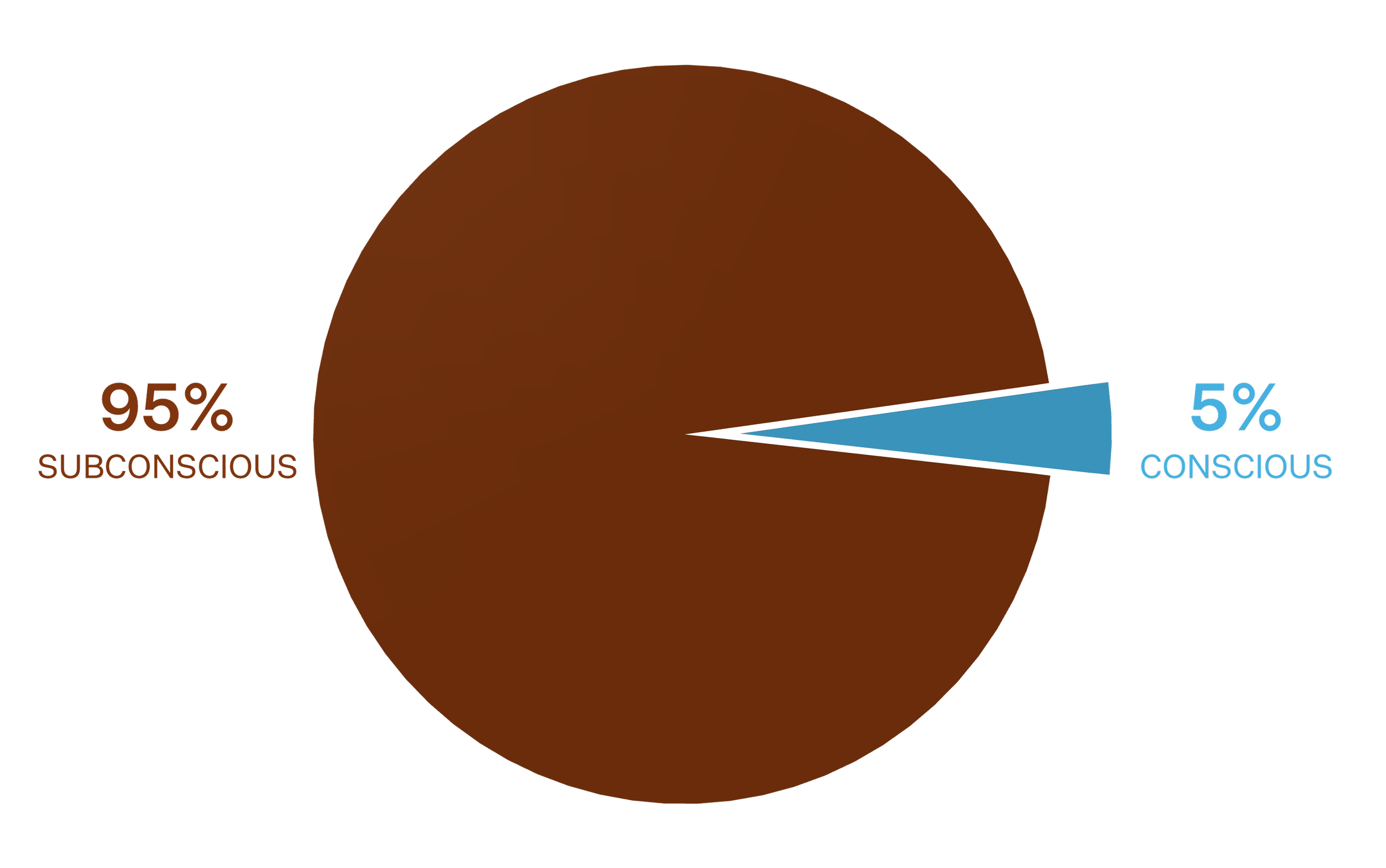
The other 95 percent of the circle represents your subconscious mind—automatic, conditioned, and largely invisible. This part of your brain runs tens of thousands of thoughts each day, shapes your state of mind, and makes most of your decisions—without you ever noticing. [1] Research suggests that this subconscious part of your brain skews negative, leading to a roughly two-to-one ratio of negative to positive thoughts. [2] This negativity bias is rooted in our ancient survival programming—designed to keep us alive, not necessarily to keep us happy.
Think of the five percent conscious part of your brain as the driver and the 95 percent unconscious part as a massively powerful (and unguided) machine. Perhaps the simplest way to change your life? Use your five percent to gently guide the other 95 percent—so your mind works for you, not against you.
“Use your five percent to gently guide the other 95 percent—so your mind works for you, not against you”
The Four Questions
There are four areas where you can direct that five percent of your mind for a disproportionately large, positive impact on your life. By focusing your conscious energy on questions related to these four areas, you can leverage the other 95 percent of your unconscious mind to work for you, which can profoundly shape your happiness and success. The four questions are:
How will I talk to myself?
How will I show up?
With whom will I share my life?
What meaningful pursuit will I work toward?
Question 1: How will I talk to myself?
There’s a Cherokee tale in which an elder tells his grandson about the two wolves fighting a battle inside each of us. One is driven by fear, comparison, resentment, and doubt. The other by peace, courage, kindness, and truth. The grandson asks: Which one wins? And the elder replies: The one you feed.
Our brains operate on a principle called neuroplasticity. Each time we think a thought, we strengthen the neural connections associated with it—like skis carving grooves in fresh snow. These grooves get deeper and faster each time we repeat the thought. We have so many repetitive thoughts because much of our mental activity is effectively on autopilot; our brains prefer to slide down the existing, well-worn tracks of yesterday rather than carve new paths for today.
Our internal dialogue shapes our entire experience of life. And yet, most of us are unaware of how harsh or limiting that dialogue actually is.
Imagine you had a coach who spoke to you all day long, encouraging you, offering perspective, and seeing you as the person you are capable of becoming? Wouldn’t that change everything?
Instead, many of us live with a constant inner critic—one that tells us we’re behind, not enough, at risk of failing, or gets stuck on past losses and regrets. The most dangerous trick this voice plays is convincing us that it is us, but it isn’t. You are the one who hears the voice, not the one who generates it. The inner critic is not keeping you safe or driving your success. Over time, it erodes joy and confidence. Awareness is the first step to loosening its grip.
Exercise:
Identify one recurring negative thought you had this year that is holding you back, interrupting your peace, or not serving you.
Become aware when your brain is stuck in the ski tracks of the old pattern of thinking. Each time that negative thought pops in (which it will!), smile and recognize that thought for what it is: an automatic response of your subconscious mind programmed for survival.
What would a wiser, older version of you say instead? That’s the new thought that can guide you in 2026.
Awareness of our thoughts—separation from them—is the most powerful tool we have in changing our internal dialogue. With practice, you’ll carve new tracks in the snow.
Question 2: How will I show up?
How you show up is one of the few things fully within your control and can most significantly change your internal and external world. Rather than focusing on standout moments—big wins or obvious failures—think about your median day in 2025. The ordinary interactions: the tone you carried into meetings, your body language in conversations, and moments with your partner, friends, or family.
Were you present or distracted? Generous or guarded? Grounded or reactive?
Most of us don’t realize that we actually get to choose how we show up. This choice lives squarely in our conscious five percent. We can decide, on purpose, to be a source of calm, energy, humor, steadiness, or encouragement. And here’s the feedback loop most of us miss: other people tend to reflect back to us the way we show up to them.
Change the quality of your presence, and your experience of the world changes with it.
Exercise:
Recall a moment this year when you were at your absolute best—fully alive, confident, and engaged. What qualities did you embody in that moment?
Each day, identify the most important interactions you’ll have and how you want to show up in each.
Each evening, reflect on how you showed up.
Practice this regularly, and your entire life will change. The world will reflect you at your best.
Question 3: With whom will I share my life?
Think about the people who filled your days this year: friends, colleagues, partners, family members, mentors. When you were under their influence, did you feel more like yourself, or less? Who among them do you admire and want to be more like? What kind of energy does each person bring? How do you feel when you’re around them?
These questions matter more than most of us are willing to admit. Over time, you become your environment. You are shaped and molded by the emotional tone, values, goals, and behaviors of the people with whom you spend the most time. Slowly and subtly, you either expand or contract. This includes not only people you see in person, but also those you interact with virtually—on Zoom, or even through social media. (Yes, the creators you follow and the voices in your podcasts are shaping you, too. You’re subconsciously brainwashing yourself with that content.)
Very few of us pause to examine our relationships directly. We often tolerate them out of habit, obligation, or history. But we have more choice than we think.
“The creators you follow and the voices in your podcasts are shaping you, too. You’re subconsciously brainwashing yourself with that content. ”
Exercise:
Energy Givers
Think about the people who consistently gave you energy this year—those who brought out your honesty, generosity, curiosity, or courage.
Consider the social media accounts, podcasts, and other content you consumed. Which of these is aligned with the person you want to become?
For 2026, who are the energizing people you want to prioritize spending more time with, following, or listening to? How can you make more time for these people?
Energy Drainers
Think about the people who drained you—those who consistently brought out the worst parts of you.
Consider the social media accounts, podcasts, and other content sources that made you feel worse after engaging with them.
Who are the people, social media accounts, or content sources you want to gently distance yourself from—or let go of entirely? How are you going to move toward this change?
Question 4: What meaningful pursuit will I move toward?
Meaning comes from knowing that your minutes, hours, and days are spent moving toward something that matters to you. In 2026, how can you take even small steps toward a pursuit that feels purposeful? Something that energizes you, challenges you, or makes time disappear?
Progress here doesn’t have to be dramatic. Often, it’s about identifying small, yet significant, things and carving out even a little time each week to move toward them.
Exercise:
Imagine it’s 2030, and you’ve spent the last five years moving steadily toward something deeply meaningful. Describe that life in the past tense.
Now ask yourself: what is one small, concrete step from that vision that you could take in the first month of 2026?
Pulling It All Together for 2026
If you do nothing else to prepare for the year ahead, use your five percent conscious mind to make these four powerful choices:
Choose your inner voice. How will you talk to yourself? Build a kinder, wiser dialogue that supports the life you want.
Choose your presence. How will you show up? Decide how you want to be—then practice it daily.
Choose your people. With whom will you share your life? Make more space for those who lift you up and set clearer boundaries with those who don’t.
Choose your pursuit. What meaningful goal will you move toward? Commit—even slowly—to something that brings you meaning.
That five percent of your mind—the one you can control—has the power to shift the other 95 percent to work for you. Be conscious of how you’re directing that 5 percent, and 2026 could be the year everything changes.
You’ve got this.